


07 April 2026

Adelaide University researchers are preparing to send living cancer cells into space aboard a suborbital rocket, in a pioneering experiment that could reveal new insights into how cancer develops and survives under extreme conditions.
The project lead researcher Dr Nirmal Robinson from the Centre for Cancer Biology and SAHMRI's Blood Cancer Program will study how cancer cells behave in microgravity – the near-weightless environment experienced in space – during a short research mission lasting about 10-12 minutes.
The initiative is supported by the State Government through the South Australian Space Collaboration and Innovation Fund and is being led in partnership with Cambrian Defence & Space and Blue Dwarf Space.
The rocket will launch from Sweden through an agreement with the Swedish Space Corporation (SSC Space), carrying cancer cells prepared by the Adelaide research team.
Scientists hope the microgravity environment will reveal biological behaviours that are difficult — or impossible — to observe in laboratories on Earth.
“Cancer cells live under enormous stress,” said Dr Robinson.
“In a tumour, cells are competing for nutrients and oxygen, and many die in that environment. Yet a small number of cells adapt and survive. Those are the cells that can become aggressive, spread through the body and resist treatment.”
Dr Robinson’s laboratory investigates how cancer cells respond to extreme stress and how some develop the ability to survive chemotherapy or metastasise.
“Even when chemotherapy kills 99% of tumour cells, there can be a single cell that survives and becomes even more dangerous. If we can understand the mechanisms that allow those cells to adapt, we may be able to develop better ways to target them.”
Sending cancer cells into microgravity offers a rare opportunity to study cell behaviour without the constant pull of gravity that influences experiments on Earth.
In normal laboratory conditions, cells grow in flat layers because gravity causes them to settle on the surface of a culture dish. In microgravity, however, cells float freely and can form three-dimensional clusters that more closely resemble real human tissue.
“When gravity is removed, cells no longer experience sedimentation and many of the mechanical forces present on Earth,” Dr Robinson said.
“That means they often grow differently – sometimes forming structures that look more like real tumours or tissues. It gives us a clearer window into how these cells behave.”
The experiment will focus on highly adaptable cancer cells, known to play a pivotal role in tumour initiation and progression. These cells can divide indefinitely and generate multiple cell types found within a tumour. Their ability to survive stress, repair tissue and rapidly change their behaviour places them at a critical tipping point where normal cellular function can shift toward cancer development and aggressiveness.
During the mission, the cells will be exposed to microgravity for several minutes before the rocket returns to Earth. Once recovered, the samples will be rapidly frozen and transported back to Adelaide, where scientists will analyse changes in gene activity and protein expression.
“We want to see how the cells respond to microgravity – whether they multiply more readily, whether they experience different stress responses, or whether certain biological pathways are activated,” Dr Robinson said.
The project will also help establish a more accessible pathway for Australian researchers to conduct experiments in space.
“This project is Australia’s first dedicated microgravity cancer research mission designed to establish a repeatable, sovereign access pathway for biomedical experiments in space,” Dr Robinson said.
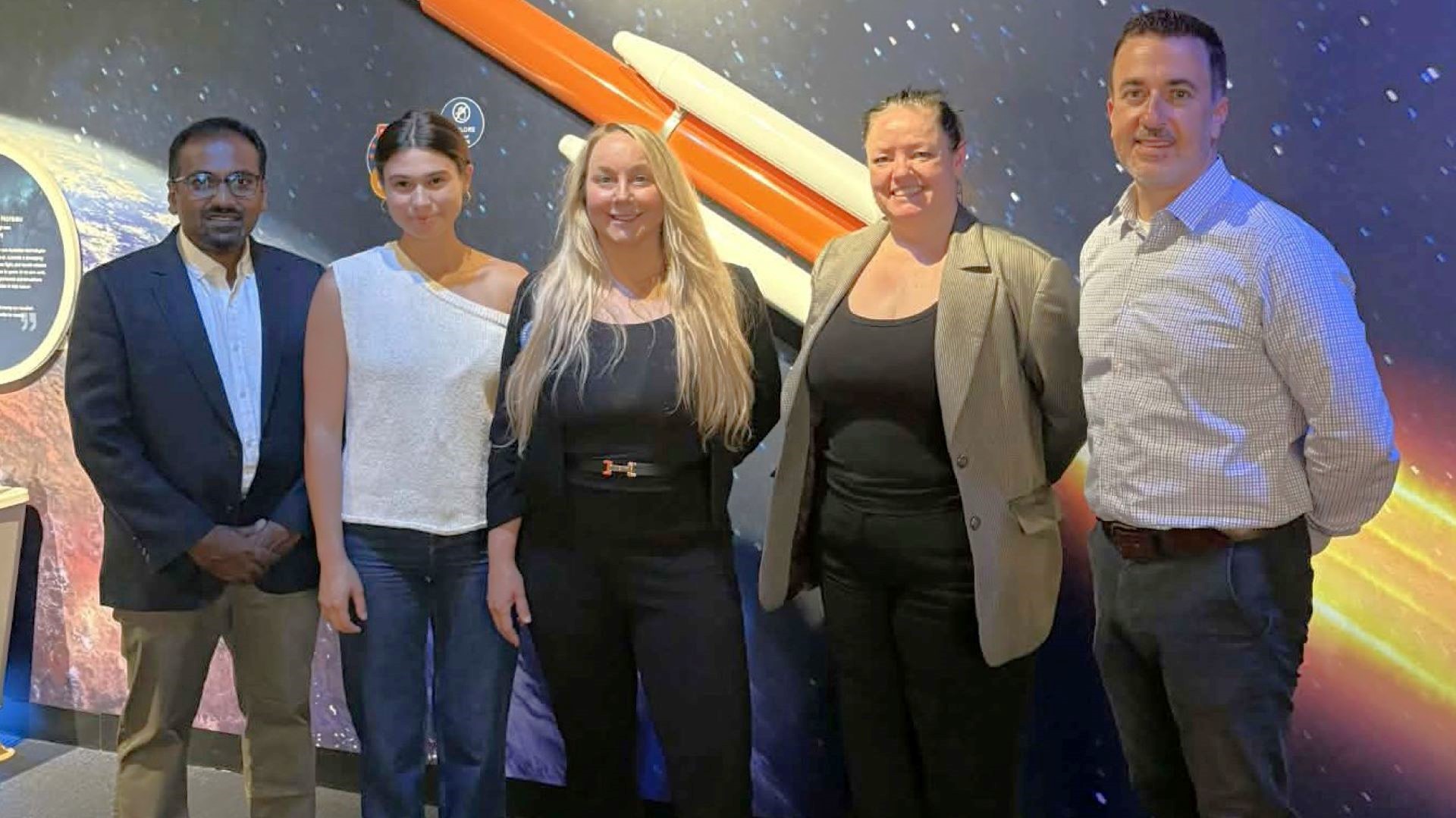
Ms Kelly Yeoh (Blue Dwarf Space) & Mr John Godwin (Cambrian Defence and Space)
“The grant team’s aim is not only to advance cancer research, but also to create opportunities for other scientists and industries to use space as a laboratory” according to grant partner, Cambrian CEO Tiffany Sharp.
The mission is expected to launch later this year.
…………………………………………………………………………………………………………………………
Media contact: Candy Gibson M: +61 434 605 142 E: candy.gibson@unisa.edu.au